
The 323-Company Question: Is Ghana Cleaning Its Business Register or Confronting a Deeper Economic Problem?
A definitive strategic review of the Office of the Registrar of Companies (ORC) Bulletin Vol. 49 dissolution notice under Act 992. Why striking off hundreds of entities exposes the tension between statutory compliance, administrative friction, and the real survival rate of Ghanaian enterprises.

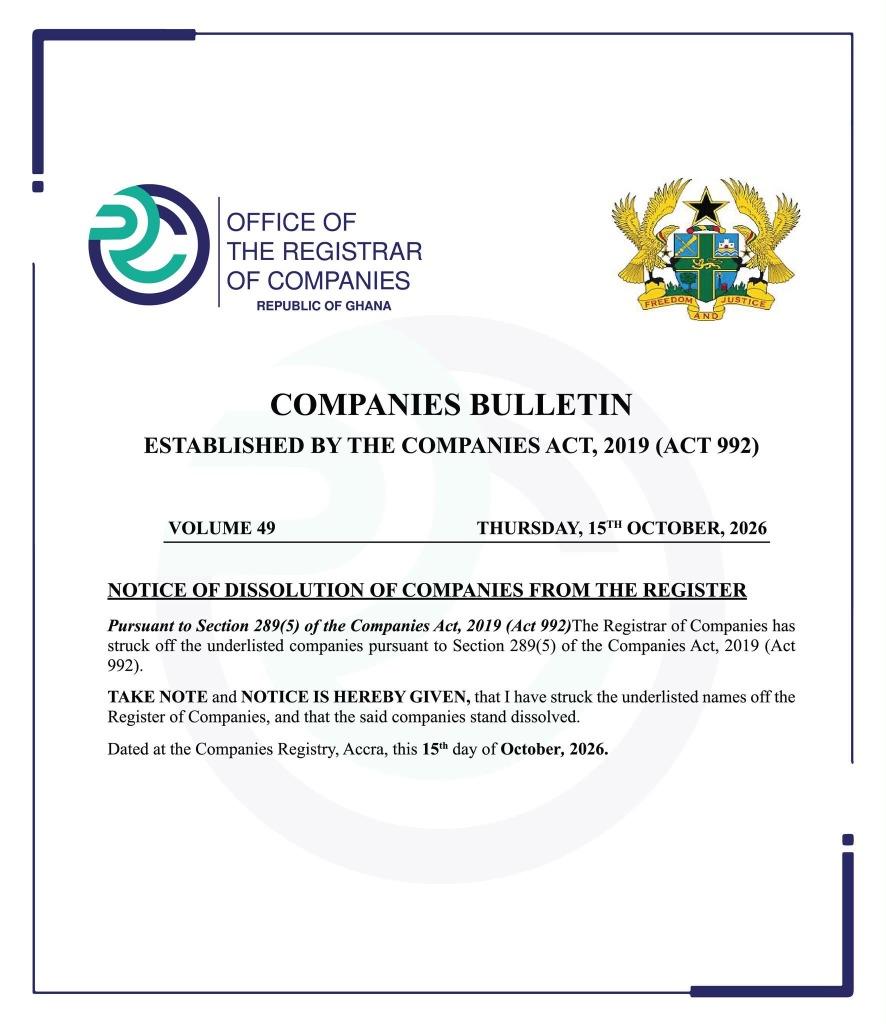
Official Gazette: The Office of the Registrar of Companies (ORC) Companies Bulletin Volume 49, published October 15, 2026, announcing the administrative strike-off and dissolution of 323 corporate entities under Section 289(5) of Act 992.
On 15 October 2026, the Office of the Registrar of Companies (ORC), under the statutory authority of Registrar Mrs. Maame Samma Peprah, published a regulatory instrument that should arrest the attention of every founder, board director, institutional lender, and economic policymaker in Ghana.
In four concise pages of its Companies Bulletin, Volume 49, the Registrar exercised the sweeping powers conferred by Section 289(5) of the Companies Act, 2019 (Act 992). With the stroke of an administrative pen, 323 corporate entities were officially struck off the national register and declared legally dissolved.
Among the 323 names appeared emblems of Ghana's modern and commercial heritage: Ghana Breweries Limited, Ashanti Cement Limited, Gold Coast Cigar Ltd, Hoechst Ghana Limited, Aluminium Manufacturing Limited, Adu Trading Limited, Ghana Poultry Ltd, and Ghana Rice Ltd.
Within days, the public discourse split into two predictable, polarized camps. One narrative celebrated the ORC's decisive enforcement of statutory discipline against delinquent paper companies. The opposing narrative sounded an alarm of economic catastrophe, presenting the bulletin as empirical proof that hundreds of Ghanaian businesses were quietly suffocating under macro-economic strain.
Both interpretations miss the mark. They confuse legal status with operational reality, and they substitute populist commentary for rigorous economic and institutional analysis.
The central question facing Ghana is far more profound: When our national registry dissolves hundreds of companies, are we witnessing the routine sanitation of a neglected administrative database, or are we diagnosing a structural failure in how Ghana nurtures, monitors, and preserves enterprise continuity?
To answer this, we must examine the intersection of corporate jurisprudence, historical industrial policy, regulatory transaction costs, and founder accountability through the lens of what we at KIA–Start Up Consult define as The Business Environment Test.
1. Dissecting the Official Record: The 323 vs. 453 Distinction
In economic analysis, rigorous data integrity is non-negotiable. The very first failure in public commentary surrounding the ORC's recent actions was the conflation of two separate legal notices issued under distinct statutory provisions.
The ORC did not dissolve 776 operational companies in November 2026. The official publications establish two distinct legal cohorts operating in fundamentally different statutory phases:
Phase One: Final Dissolution under Bulletin Volume 49
Under Volume 49 of the Companies Bulletin (dated 15 October 2026), the Registrar executed final strike-off actions against 323 companies pursuant to Section 289(5) of Act 992. These entities had previously received statutory inquiry notices and had already exhausted their three-month gazette warning period (originally signaled in Bulletin Volume 40) without showing cause. They are legally dead. Their corporate existence has terminated.
Phase Two: Notice of Intended Strike-Off under Bulletin Volume 48
Published in tandem with Volume 49, Volume 48 of the Companies Bulletin served as an administrative warning shot to 453 companies under Section 289(3) of Act 992. These 453 entities have not been dissolved. They have been placed on statutory notice and granted a three-month window to regularize their status, file outstanding returns, settle statutory penalties, and demonstrate that they are actively carrying on business.
Conflating these two figures produces an erroneous headline of "776 businesses collapsed." Such reporting obscures the reality of regulatory mechanics and inflates perceived systemic panic.
A credible commercial environment requires precise distinctions between entities that have exhausted all statutory remedies and those currently navigating an active window of administrative cure.
“A national company register is not a vanity metric of national ambition; it is the legal foundation upon which credit, ownership, employment, and investment confidence rest.”
2. The Statutory Architecture: Decoding Section 289 of Act 992
To understand why the Registrar acted, one must understand the mechanics of the law. The dissolution was executed under Section 289 of the Companies Act, 2019 (Act 992), titled Striking Names of Defunct Companies off Register.
Far from being an arbitrary executive ambush, Section 289 establishes a multi-tiered, due-process mechanism designed to balance registry integrity with corporate protection:
Reasonable Cause Threshold (Section 289(1)):
The process begins only when the Registrar has reasonable grounds to believe that a company is not carrying on business or is not in operation. In practice, chronic non-filing of Annual Returns under Section 126 serves as primary prima facie evidence of dormancy.
First Written Inquiry (Section 289(1)):
The Registrar transmits a formal written letter inquiring whether the company is actively operating.
Registered Follow-Up Notice (Section 289(2)):
If the Registrar receives no response within one month, a second registered communication is dispatched within fourteen days, warning that a failure to reply within one month will trigger gazette action.
The Three-Month Gazette Warning (Section 289(3)):
If no answer is received, or if the company confirms inactivity, the Registrar publishes a notification in the Companies Bulletin stating that at the expiration of three months from the notice date, the company will be struck off and dissolved.
Final Dissolution & Gazette Notice (Section 289(5)):
Unless the company shows sufficient cause to the contrary within the three-month period, the Registrar strikes the name from the register and publishes the dissolution notice in the Bulletin. The company stands dissolved upon publication.
This statutory sequence demonstrates that administrative dissolution is never sudden. It is the culmination of a protracted regulatory dialogue—or, more accurately, an administrative silence.
The law cannot permit companies to remain registered in perpetuity while refusing to communicate with the state. An unmonitored register invites corporate fraud, shields shell entities used for illicit finance, creates phantom liabilities, and severely distorts national economic statistics.
3. The "Ghost Company" Fallacy: Why Dissolution ≠ Economic Collapse
The most intellectually misleading claim following Bulletin Volume 49 was that the strike-off of marquee names signaled the sudden demise of industrial titans.
Consider the prominent inclusion of Ghana Breweries Limited (GBL) on the dissolution list. To an uninformed observer, seeing Ghana Breweries Limited struck off in October 2026 reads like a catastrophe in domestic manufacturing.
The actual corporate history tells the exact opposite story:
In December 2003, Guinness Ghana Limited (backed by Diageo PLC) announced a landmark deal to acquire Ghana Breweries Limited (backed by Heineken B.V.), uniting legendary production facilities in Kumasi and Achimota. By late 2004, the transaction was finalized, and the combined powerhouse was christened Guinness Ghana Breweries Limited (GGBL, now PLC).
In April 2005, Ghana Breweries Limited was formally de-listed from the Ghana Stock Exchange (GSE). Its real-world operations, factories, brewing assets, commercial lines, and workforce did not evaporate; they were absorbed, consolidated, and scaled under GGBL, which remains one of Ghana's largest industrial employers and taxpayers today.
What sat in the ORC registry for the past twenty-one years was not an active brewery, but a dormant legacy corporate shell—a legal ghost that outlived its operational relevance.
A similar dynamic applies to entities like Hoechst Ghana Limited, a subsidiary of the historic German chemical and life-sciences conglomerate that underwent global restructuring, de-mergers, and brand reallocations decades ago.
This reveals what we term the Ghost Company Fallacy:
- Case A: The Dormant Shell. An enterprise was restructured, acquired, or ceased trading decades ago, but nobody bothered to execute a formal winding up under the Corporate Insolvency and Restructuring Act, 2020 (Act 1015).
- Case B: The Abandoned Idea. A founder registered a company with grand ambitions, printed business cards, opened an Instagram page, and abandoned the venture six months later without filing a single return.
- Case C: The Comatose Trader. An enterprise is actively buying, selling, employing workers, and taking loans, but has treated statutory compliance with reckless contempt.
The ORC's 323-company bulletin bundles all three categories into an identical legal grave.
Policymakers must not treat the dissolution of a 30-year-old empty legal shell with the same gravity as the operational failure of an active employer. Without granular corporate data that disaggregates shell cleanups from commercial liquidations, Ghana's economic planners are navigating in the dark.
“A company certificate gives an entity legal birth; customers give it cash flow; governance gives it longevity. When a registry dissolves a shell, it is simply burying a corpse that died decades ago.”
4. The Hidden Tax of an Unsanitized Business Register
While regulatory purists defend the strike-off and economic fatalists mourn it, few have articulated the systemic economic hazard of maintaining an inaccurate national register.
A registry filled with defunct, untraceable entities imposes severe negative externalities across the wider economy:
Sanitizing the register is therefore not bureaucratic cruelty; it is fundamental market infrastructure.
A modern capitalist economy requires high-integrity records. If the ORC fails to purge defunct entities, the integrity of every corporate instrument issued in Ghana—from share certificates to debentures—is compromised.
5. The Dual Burden: Regulatory Friction Meets Founder Neglect
The health of Ghana's business environment cannot be sustained by institutional enforcement alone. It requires an honest audit of both sides of the regulatory equation: the efficiency of the state and the discipline of the entrepreneur.
The Institutional Reality: Compliance as an Obstacle Course
Why do operating companies fall behind on statutory obligations? While some founders are negligent, many are exhausted by administrative friction.
For an entrepreneur outside Accra, or a small business owner without a dedicated in-house legal department or retained company secretary, interacting with regulatory systems in Ghana has historically been fraught with friction. Portals that crash during deadline peaks, conflicting directives between the ORC, GRA, and local Municipal Assemblies, opaque penalty calculation schedules, and customer-service desks characterized by bureaucratic inertia turn routine compliance into an expensive distraction.
When the friction of obeying the law exceeds the perceived penalty of ignoring it, businesses naturally drift into informal non-compliance.
The Founder Reality: Incorporation Without Responsibility
Conversely, Ghanaian business culture suffers from an epidemic of corporate negligence.
Thousands of founders view company registration as a celebratory graduation ceremony rather than an ongoing legal governance compact. Once the Certificate of Incorporation is framed and hung on the office wall, statutory obligations are forgotten:
An entrepreneur who demands world-class infrastructure and foreign direct investment must exhibit the baseline governance discipline required of a registered corporate citizen. A limited liability company is a legal privilege granted by the Republic; it is not an unconditional right to operate without accountability.
6. Rethinking the Gazette: The Case for a Digital Overhaul
The dissolution notice highlights an archaic operational assumption: that published gazettes and printed bulletined lists satisfy modern standards of corporate communication.
Under Act 992, publishing a notice in the Companies Bulletin legally satisfies the requirement of public notification. But in an era where Ghana has pioneered real-time mobile interoperability, digital tax invoicing (e-VAT), and biometric national identity (Ghana Card), relying on a quarterly PDF uploaded to a government sub-domain to announce the corporate death of 323 enterprises is a 20th-century solution to a 21st-century reality.
Consider what a human-centered regulatory communication architecture should look like:
Biometrically Anchored Corporate Dashboards:
Link every company profile directly to the Ghana Card PINs of its registered directors and Company Secretary.
Automated Multi-Channel Warning Systems:
Trigger automated SMS, verified email alerts, and portal dashboard flags 90 days, 60 days, and 30 days before statutory deadlines and strike-off procedures.
Traceable Proof of Service:
Establish digital audit trails demonstrating that statutory inquiry notices under Section 289 were actively delivered to and opened by the company's designated officers.
Instant Self-Service Cures:
Enable directors to cure filing defaults, upload financial statements, and settle penalty invoices instantly via mobile money or bank cards without stepping into an ORC office.
When notices are hidden within 40-page PDF bulletins, compliance remains reactive and punitive. When compliance alerts are pushed proactively to the founder's phone, compliance becomes an automated operational routine.
7. The 5-Pillar Blueprint: A National Business Life-Cycle System
If Ghana is serious about building a business environment that fosters enterprise longevity, the mandate of the ORC must evolve.
The institution cannot merely serve as a birth registry (incorporation) and a morgue (dissolution). It must transform into an intelligent, data-driven Business Life-Cycle Management System.
We propose five structural reforms to modernize Ghana's corporate administration:
Unified Enterprise Life-Cycle Portal:
Merge company registration, annual returns, regulatory filings, beneficial ownership updates, and good-standing certification into a single, intuitive digital interface accessible on mobile and desktop.
Predictive Compliance Notifications:
Deploy automated algorithmic reminders triggered at 60-day, 30-day, and 14-day intervals prior to the company's incorporation anniversary, detailing exact fees, penalty calculations, and required statutory forms.
Transparent Service-Level Agreements (SLAs):
Institute public-facing processing clocks for every filing, name search, amendment, and restoration, with mandated escalation protocols when timelines are breached.
Institutional Integration & Data Interoperability:
Securely connect ORC systems with the Ghana Revenue Authority (GRA), Social Security and National Insurance Trust (SSNIT), and the Ghana Investment Promotion Centre (GIPC) to eliminate redundant filings and give regulators a unified view of enterprise health.
National Business Mortality & Health Observatory:
Publish quarterly anonymized analytical reports documenting business formation rates, compliance health indices, dormancy drivers, and sectoral mortality trends to guide national industrial policy.
By executing these five reforms, the ORC can shift from an episodic enforcement agency to an indispensable partner in national economic development.
8. The Founder's Action Guide: How to Protect Your Entity or Seek Restoration
For entrepreneurs, directors, and corporate advisors, Bulletin Volume 49 is a sharp reminder that corporate maintenance is an active responsibility.
Every enterprise operating in Ghana should immediately execute the following three-stage governance audit:
Stage 1: Immediate Registry Status Audit
- Step 1: Visit the official ORC portal or engage an accredited corporate consultancy to conduct a formal search on your company's registration number and current legal standing.
- Step 2: Verify that your entity does not appear on Bulletin Volume 48 (the 453 companies on 90-day show-cause notice) or Volume 49 (the 323 dissolved companies).
- Step 3: Confirm that the ORC's database reflects your current physical office address, active corporate email, and updated director particulars.
Stage 2: Annual Return Regularization
- Step 4: Ensure that Annual Returns (Form 11) have been submitted for every completed year of incorporation since registration.
- Step 5: Prepare and annex the statutory Financial Statements (audited statements for companies exceeding standard thresholds, or an unaudited Statement of Affairs for micro-enterprises).
- Step 6: Settle any accrued statutory late penalties immediately to prevent default flags from escalating to strike-off proceedings.
Stage 3: The Restoration Procedure (If Already Dissolved)
If your company has already been struck off under Bulletin Volume 49 or prior notices, the legal door is not entirely closed. Act 992 provides an orderly avenue for corporate resuscitation:
- Step 7: Invoke Section 289(7) of Act 992. If a company, member, or creditor feels aggrieved by the strike-off, an application may be brought before the High Court within 20 years of the dissolution notice.
- Step 8: Demonstrate to the Court that the company was, at the time of striking off, carrying on business or in operation, or establish that it is otherwise just and equitable that the company be restored.
- Step 9: Upon securing a High Court Order for Restoration, deliver a certified copy to the Registrar of Companies, settle all outstanding returns and restoration fees, and publish the restoration in the Bulletin. The law deems the company to have continued in existence as if its name had never been struck off.
“Statutory compliance is not an administrative tax on growth; it is the legal armour that safeguards your equity, preserves limited liability, and validates your commercial integrity.”
9. Conclusion: Beyond the Register — Measuring Enterprise Survival
The 323-company question is not whether the Registrar was legally justified in issuing Bulletin Volume 49. The law is clear, and the Registrar executed her statutory mandate with fidelity to Act 992.
The real question is what Ghana intends to do with the economic reality this notice reveals.
A country cannot measure entrepreneurial success by the number of certificates it issues at registration counters every January. Registering a company is an afternoon transaction; sustaining a productive, profitable, tax-paying, and job-creating enterprise is a decades-long war against market friction.
If Ghana is to build an economy capable of anchoring African industrialization, we must graduate from an obsession with enterprise creation to an obsession with enterprise endurance.
The register is a mirror. If it reflects hundreds of dead and comatose businesses, our duty is not merely to wipe the glass clean. Our duty is to look behind the mirror—to reform the tax architecture, lower regulatory compliance friction, deepen access to patient capital, instill corporate governance discipline in our founders, and build public institutions that work at the speed of modern commerce.
A certificate of incorporation gives a business legal existence. Loyal customers give it cash flow. Rigorous governance gives it discipline. But only an enabling, predictable, and supportive business environment gives it the opportunity to endure as an enduring national institution.
That is the Ghanaian enterprise ecosystem we must build.
---
Official Citations & Regulatory References
- Office of the Registrar of Companies (ORC): Companies Bulletin Volume 49 — Notice of Dissolution of Companies from the Register Under Section 289(5), Accra, Thursday, 15th October 2026.
- Office of the Registrar of Companies (ORC): Companies Bulletin Volume 48 — Notice of Intention to Strike Off Companies Under Section 289(3), Accra, October 2026.
- Parliament of the Republic of Ghana: Companies Act, 2019 (Act 992), Sections 126 (Annual Returns), 289 (Striking Names of Defunct Companies off Register), and 290.
- Corporate Insolvency and Restructuring Act, 2020 (Act 1015): Official statutory provisions governing winding up and administration.
- Ghana Stock Exchange (GSE): Official Notice of De-Listing: Ghana Breweries Limited (GBL), April 2005.
- Legal dissolution under Section 289(5) of Act 992 is an administrative removal for non-operation or statutory non-compliance, not necessarily an overnight industrial collapse.
- Conflating the 323 dissolved entities in Bulletin Vol. 49 with the 453 companies placed on 90-day show-cause notice in Bulletin Vol. 48 creates a false narrative of 776 sudden business failures.
- Historical case studies prove the registry lag: household names like Ghana Breweries Limited (GBL) merged into Guinness Ghana Breweries (GGBL) in 2004; its 2026 strike-off is the cleanup of a legacy shell, not a contemporary factory closure.
- An uncleaned company register pollutes the credit market, elevates due-diligence friction, and inflates cost of capital for compliant businesses across Ghana.
- Ghanaian entrepreneurs carry a legal duty under Section 126 to file Annual Returns within 42 days of their anniversary; treating incorporation as a one-time paper exercise is fatal to business continuity.
- ORC must transition from a punitive gazette-driven enforcement model to a proactive Business Life-Cycle Management System featuring automated push notifications and self-service compliance dashboards.
People Also Ask
Q1.What does it mean when a company is struck off and dissolved by the ORC under Section 289?
Under Section 289(5) of the Companies Act, 2019 (Act 992), when the Registrar has reasonable cause to believe a company is no longer operating or carrying on business, and the company fails to respond to statutory inquiry letters and a 3-month gazette notice, the Registrar strikes its name off the register. Upon publication of the strike-off notice in the Companies Bulletin, the company legally ceases to exist as a corporate body, its legal capacity terminates, and any remaining corporate property vests in the State as bona vacantia subject to restoration provisions.
Q2.What is the difference between Bulletin Volume 49 (323 companies) and Volume 48 (453 companies)?
Bulletin Volume 49 (published 15 October 2026) is a final Notice of Dissolution under Section 289(5); the 323 listed companies have already been struck off and stand legally dissolved. In contrast, Bulletin Volume 48 (published concurrently) is a Notice of Intention to Strike Off under Section 289(3); the 453 companies listed there have been granted a statutory 3-month grace period to show cause why their names should not be struck off. Conflating the two numbers into '776 collapsed companies' is legally and factually inaccurate.
Q3.Does the dissolution of legacy names like Ghana Breweries Limited mean those businesses recently collapsed?
No. Many entities struck off under administrative cleanup exercises ceased trading decades ago or were absorbed through mergers and acquisitions. For example, Ghana Breweries Limited (GBL) was acquired by and integrated into Guinness Ghana Limited in 2004 to create Guinness Ghana Breweries Limited (GGBL, now PLC), and its shares were de-listed from the Ghana Stock Exchange in 2005. The underlying brewery operations, factories, and brands (such as Star Beer) continue operating today under GGBL; the 2026 ORC notice merely dissolved the dormant legacy corporate shell.
Q4.Can a company dissolved under Section 289 be restored to the register in Ghana?
Yes. Under Section 289(7) of Act 992, if a company, member, or creditor feels aggrieved by the strike-off, an application can be made to the High Court within 20 years from the publication of the dissolution notice. If the High Court is satisfied that the company was at the time of strike-off carrying on business or that it is just to restore it, the Court may order the company restored to the register. Upon filing the court order with the ORC, the company is deemed to have continued in existence as if its name had never been struck off.
Q5.What must Ghanaian business owners do to prevent their company from being struck off?
Companies must comply with their annual statutory obligations under Act 992. This requires filing Annual Returns (Form 11) with the ORC within 42 days of the company's incorporation anniversary date, accompanied by financial statements (or statement of affairs for non-trading companies), promptly updating the register when directors, secretaries, or registered office addresses change (Forms 16 and 17), and actively monitoring official ORC notices and verified digital portal profiles.
Have a question or looking to implement this strategy?
Our partners and sector specialists are available for direct discussion on WhatsApp. Every conversation is tailored to your business or institutional context.
How to Register a Company in Ghana in 2026: The Complete ORC Step-by-Step Guide
A definitive, plain-English walkthrough of company registration in Ghana under the Companies Act 2019 (Act 992) — covering every document, fee, timeline, and compliance obligation you need to get your business legally operational.
The Complete Guide to Formalizing an Informal Enterprise in Ghana
A comprehensive, step-by-step masterclass on transforming an unregistered hustle or sole proprietorship into a protected, bankable, and scalable limited company.