
The Missing Architecture: Why African Enterprise Needs Systems, Not Just Training
Africa does not lack entrepreneurial talent or vibrant ideas. It lacks the integrated economic architecture that connects skills to enterprise, enterprise to capital, and capital to sustainable productivity.

Isaac Agya Koomson
Chief Executive Officer, KIA–Start Up Consult Ltd
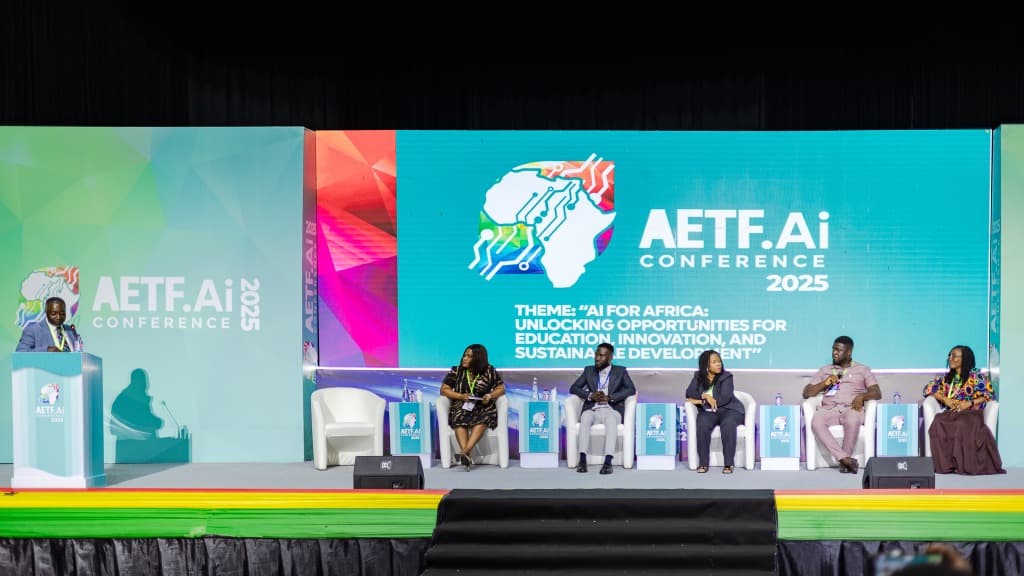
Presenting on economic systems and continental transformation at the AETF.Ai Conference.
For decades, development interventions across sub-Saharan Africa have operated under an unspoken assumption: train enough individuals, distribute micro-grants, and sustainable economic transformation will follow naturally. The empirical reality tells a sobering story. While Africa boasts the highest rate of entrepreneurship per capita globally, it simultaneously suffers from the highest venture mortality rate and lowest average productivity per SME. The fundamental bottleneck is not lack of individual drive — it is the absence of coordinated economic architecture.
The Disconnected Pipeline
In a functional economy, six core layers exist in continuous synchronization: Policy sets the regulatory and fiscal framework; Skills equip the workforce; Enterprises structure ideas into bankable legal vehicles; Capital provides patient growth fuel; Technology optimizes operations; and Markets absorb the resulting output.
Across most African ecosystems today, these layers exist as isolated islands. Universities graduate thousands of ambitious young minds who enter a vacuum of uncoordinated enterprise infrastructure. Microfinance lenders offer high-interest capital to informal operators who lack standard accounting systems. Governments launch ambitious national transformation agendas that fail to reach the street-level SME.
“Africa is not a continent of problems to be solved. It is a continent of systems waiting to be built correctly.”
Moving from Subsistence to Productivity
Real economic transformation occurs when micro-enterprises transition into productive, formalized, tax-paying, and employable institutions. This transition cannot happen through unassisted hustle. It requires structured enterprise development pipelines.
Through platforms like the Adwuma Enterprise Pipeline™ and Nkabom Business Advance™, KIA–Start Up Consult bridges this chasm by designing the technical mechanisms that convert raw human potential into formal economic machinery.
The Role of Institutional Alignment
To achieve continental scale, interventions must align with macroeconomic targets — including the African Union Agenda 2063, AfCFTA trade corridors, and United Nations Sustainable Development Goals.
When national ministries, bilateral development agencies, and private capital providers align behind a unified architecture, transactional friction drops, systemic risk is mitigated, and capital mobilizes at multiples previously deemed impossible.
- Entrepreneurship training without an integrated capital and market architecture yields high venture mortality.
- Systemic formalization and digital operational infrastructure are prerequisite conditions for SME scalability.
- Institutional alignment between government frameworks and private capital is essential to achieve long-term economic sovereignty.
Have a question or looking to implement this strategy?
Our partners and sector specialists are available for direct discussion on WhatsApp. Every conversation is tailored to your business or institutional context.
From Ideation to Investment Readiness: A Blueprint for Ghanaian Startups
Why 90% of pitch decks fail to secure capital, and the foundational disciplines Ghanaian founders must master before approaching institutional investors.
AI for African Industry: Practical Adoption Frameworks for SMEs
Cutting through the hype to deliver practical artificial intelligence and automation frameworks that reduce operating costs and boost productivity for African businesses.
Financing the Next African Economy: Blended Capital & Green Growth
How blended finance, catalytic philanthropy, and impact investment can bridge the $330B SME financing gap across sub-Saharan Africa.